Senate Week: The Big Ten
The Big 10 Conference, that is. Our September Senate check-in kicks off in the Midwest (I do not acknowledge the most recent rounds of incoherent and ahistoric expansion that turned the Big Ten into a coast-to-coast league). We’ve perhaps been over-trained in recent decades to think of this region as the be-all and end-all in terms of swing states – but while there are competitive Senate races all over the country this year, it is true that the Midwest will play a major role.
I’ll summarize each race in a sentence first, then link to the longer write-up further down the page. Enjoy. And for a quick overview, check out the Welcome to Senate Week post from earlier this morning.
Read more: Senate Week: The Big TenIllinois
Incumbent: Dick Durbin (D – retiring)
2026 matchup: Julianna Stratton (D) vs. Don Tracy (R)
In a sentence: Republicans were unable to build upon their much-improved performance here in the 2024 presidential race, and failed to recruit a competitive candidate. Read more.
Iowa
Incumbent: Joni Ernst (R – retiring)
2026 matchup: Josh Turek (D) vs. Ashley Hinson (R)
In a sentence: Iowa is back on the political map but the gubernatorial race looks to be a considerably easier lift for Democrats than the Senate contest. Read more.
Michigan
Incumbent: Gary Peters (D – retiring)
2026 matchup: Abdul El-Sayed (D) vs. Mike Rogers (R)
In a sentence: Mike Rogers is running like it’s either 2002 or 2024; Abdul El-Sayed is running like it’s 2026. Read more.
Minnesota
Incumbent: Tina Smith (D – retiring)
2026 matchup: Peggy Flanagan (D) vs. Michele Tafoya (R)
In a sentence: Minnesota is ground zero for some of the biggest interwoven and likely offsetting political and governmental stories of the year. Read more.
Nebraska
Incumbent: Pete Ricketts (R)
2026 matchup: Pete Ricketts (R) vs. Dan Osborn (I)
In a sentence: Osborn is attempting to finish what he started in 2024 and prove that an independent can flip a red state Senate seat. Read more.
Ohio (special election)
Incumbent: Jon Husted (R)
2026 matchup: Sherrod Brown (D) vs. Jon Husted (R)
In a sentence: With a race pitting a defeated senator from 2024 against the man appointed to replace the new vice president, Ohio will tell us much about just how far removed we are politically from the last set of federal elections. Read more.
Illinois: After 30 years in the Senate and a lengthy stint as the Democrats’ second-in-command, Dick Durbin is retiring this year. Lieutenant Governor (and former state rep) Juliana Stratton defeated a pair of Chicago-area congressmembers in the Democratic primary, all but securing her election in this safely blue state. Durbin hails from Downstate Illinois and Stratton is from the South Side of Chicago, so her election will represent a geographic shift in the state’s Congressional delegation.
And it will be her election. Trump sharply reduced his losing margin in Illinois the third time around, but Republicans are not poised to mount competitive challenges in federal races here this year. That starts with weak candidate recruitment. The GOP nominee is Don Tracy, a former state party chair and unsuccessful candidate for LG way back in 2010. That year also happens to be the last time Republicans won a U.S. Senate seat in Illinois, when Congressman Mark Kirk edged out Alexi Giannoulias to flip what had previously been Barack Obama’s seat. With his decidedly moderate profile, Kirk was probably the only Republican who could have pulled off a win in this state even in such a red year. Tracy does not have Kirk’s skills, nor is this year anywhere near as favorable to his party as 2010 was. Stratton will win with ease.
Rating: Safe Dem (hold)
Iowa: In 2014, state senator and Army National Guard veteran Joni Ernst rode a Republican wave and some talk of pig castration to a comfortable win and flipped this open seat, long held by Democrat Tom Harkin. Polling indicated she was in a competitive race six years later, and she did in fact run a couple points behind Donald Trump – but she was still re-elected comfortably. This time around, it was starting to look like Ernst was really in trouble: Trump’s tariffs were hitting Iowa farmers hard, her own approval ratings were slipping, and she demonstrated poor political instincts. After a constituent told her that the SNAP and Medicaid cuts she voted for would cost lives, she responded that “we are all going to die.” Factually true, but tactless. She then made sure that the controversy was the one thing that wouldn’t die by filming this video in a graveyard. Mocking your constituents’ health concerns is a suboptimal approach to representation – perhaps understanding this, she declined to see re-election.
Three-term congresswoman Ashley Hinson will carry the GOP banner instead. She flipped Iowa’s 1st district in 2020 and has held the seat (now re-numbered as IA-2) since, including a landslide win two years ago. A former news anchor in Cedar Rapids, she has strong name recognition and is generally a more skillful operator than Ernst. But she faces the ongoing Trump-induced headwinds mentioned above, along with an intriguing Democratic candidate in state rep and two-time gold medal-winning paralympian Josh Turek. Like Hinson, he has won in purple territory. But while his bio intrigues, talk is starting to mount of lackluster fundraising and an unnoticeable campaign. The two highest-quality polls in the field are split, with a Fox News poll showing Turek up four points and a NYT/Siena poll showing Hinson ahead by two. It is my strong belief that Iowa in 2026 is going to look much more like the highly-competitive state that it was in the first Trump midterm (2018) than the state that delivered a blowout win for Trump two years ago. Outgoing governor Kim Reynolds is unpopular. Auditor Rob Sand seems well-positioned to succeed her against a flawed opponent. But Turek faces a fundraising deficit and a much stronger foe than Sand does, and for the moment I give Hinson a narrow edge. But Iowa is absolutely back on the board for Democrats up and down the ballot, despite having fallen so far out of reach in recent presidential elections.
Rating: Tilt Republican (hold)
Michigan: I’m not going to dwell on the Democratic primary here: enough gnashing of teeth has taken place in other venues, both from Haley Stevens fans and Abdul El-Sayed fans (I was more of a Mallory McMorrow man myself, but she dropped out before the primary for reasons that might warrant a separate post down the road). The narrow victor was El-Sayed, an epidemiologist who previous served as Wayne County’s Director of Health, Human and Veterans Services; before that he led the City of Detroit’s Health Department and was a Columbia University faculty member in their School of Public Health. He has been a prolific scholar with a focus on public health policy and disparities. His experience in the field has inspired his outspoken support of Medicare for All, part of a longstanding alignment with Bernie Sanders as well as the progressive wing of the Democratic Party – though he does not identify as a democratic socialist. He is also vocal about ending U.S. military aid to Israel – a position he sometimes articulates with nuance and sometimes does not. His judgement can be poor when it comes to those with whom he associates: it took him too long to get there, but he did eventually disavow Hasan Piker’s comments about America deserving 9/11. El-Sayed sometimes seems to think politics is contested in a fin-de-siecle Vienna salon rather than the shorthand vernacular of a country of busy people looking for a quick signal that you’re with them or against them on the issues they deem critical to their lives. And it’s not like he lacks political aptitude: this is a guy who’s quick on his feet. No less skilled a politician than Bill Clinton told him to pursue public service after hearing him give the senior class commencement speech at his University of Michigan graduation. The Pod Save America guys, who are imperfect in their 2020s-era analysis but whose political instincts and speechwriting abilities helped Barack Obama win two decisive presidential elections, have long taken an interest in El-Sayed. Clinton and Obama were distinctive politicians because they matched eloquence with an ability to rise to the moment and meet voters where they were – El-Sayed has the former but still must prove the latter.
In sum, El-Sayed has the ability to connect with an array of voters, yet has provided an opening for Mike Rogers, a former FBI agent and seven-term Congressman who narrowly lost a Senate big in 2024. Rogers generally won re-election handily during his time in Congress but he does not stand out as an especially gifted politician, nor as someone committed to Michigan: he bought a multi-million dollar mansion in Florida in 2022 and only “moved back” to Michigan for his Senate campaigns. He’s anti-choice in a purple state, having co-sponsored a national abortion ban and then endorsing the Supreme Court’s Dobbs ruling during his, well, abortive presidential campaign in 2023. And after opposing Donald Trump’s efforts to overturn the 2020 election result, he is now interested in re-litigating that election as well as his own Senate defeat two years ago. This doesn’t seem like a Republican profile that could prevail in 2026, when the political winds have shifted against the party. But El-Sayed presents a target-rich environment. So Rogers is making a play for Michigan Democrats whose support of Israel makes El-Sayed an awkward fit – granted, a dwindling subset of the party these days. That effort is itself made awkward, though, by AIPAC’s desire to continue its fight against El-Sayed while Rogers considers them a political liability in the general election. He campaigned recently with retiring Detroit state rep Karen Whitsett, who remains nominally a Dem but left their caucus in 2025 and has more nice things to say about Donald Trump and the wonders of hydroxychloroquine than she does anyone in her own party. Will it be enough for a conservative Republican to win one of the ultimate swing states at a time when national Republicans are faring poorly? I don’t quite think so. Both candidates can point to general election polls showing them in front, with AES leading more often. But only one can point to a national environment showing their party with a commanding lead.
Rating: Tilt Dem (hold)
Minnesota: The Land of 10,000 Lakes is rarely the bluest state, and yet it has been steadfastly loyal to Democrats over the last forty years. It maintains the longest streak of any state when it comes to voting for Democratic presidential nominees, starting in 1976. It was the only state to vote against Ronald Reagan in 1984, when Walter Mondale eked out a win in his home state to prevent a 50-state landslide. It has defied difficult years for Dems in more recent times, too. Democrats flipped the governorship against the national tide in 2010. Then, in 2014, Democratic Senate seats fell all over the country but Al Franken won re-election here in a landslide. Its outcome in recent presidential races was never really in doubt during Trump’s 2016 and 2024 victories. Other than Franken and Amy Klobuchar, the margins rarely reach double-digits – unlike states like Michigan, Pennsylvania and Wisconsin, where landslide Democratic wins have been sprinkled in with the razor’s edge defeats of national consequence. But the wins come all the same, with the pattern likely to continue this year.
Tina Smith is retiring after one full term in the Senate; she also finished out part of Franken’s second term following his resignation. That opened the doors for a hotly-contested Democratic-Farmer-Labor Party (as it is known here) primary between lieutenant governor Peggy Flanagan, occupying the more progressive lane (Medicare for All, universal childcare, and the increasingly-mainstream positions of replacing ICE with a new agency and ending military aid to Israel) and four-term Congresswoman Angie Craig, with a more moderate profile. Both started their electoral careers in the Twin Cities suburbs – Flanagan to the west and Craig to the south. Craig vastly outspent Flanagan in the primary, but the LG won by 20 points. Meanwhile, former NBC Sports sideline reporter Michele Tafoya easily won the GOP primary over a cast of characters that included Royce White, the party’s 2024 nominee who has followed up a reasonably successful career in Canada’s National Basketball League with a mediocre career as a far-right conspiracy theorist. Tafoya manages to avoid White’s truly outlandish behavior but is prone to exaggerations of her own (for example, she likes to say that 30% of the people in her native state of California are homeless each night; the real figure is less than 0.5%). After initially urging Trump not to run again, she now offers a boilerplate MAGA-era conservative profile in a state that has never embraced MAGA – and in a year where MAGA seems poised for widespread rejection by voters.
Flanagan is unlikely to command the levels of crossover support that Klobuchar or Franken did in their Senate elections, and faces one major weakness, even if it is not one of her creation: the fraud scandals that have – along with the state-sanctioned street killings of peaceful protestors – dominated headlines in Minnesota this year. It should be noted that these are in fact intertwined, as the Trump administration has used the involvement of Somali-Americans in the Feeding Our Future scandal as justification for ending protect status for some of the state’s Somali refugees. And indeed, many of the fraudsters were members of Minnesota’s large Somali community, though the ringleader is white. But that is not the only high-profile fraud case roiling Minnesota this year; the state’s Medicaid programs have also been beset with massive fraud schemes taking advantage of previously non-existent oversight. Flanagan has argued that she had no role to play in stopping any of this, but voters may argue she should have, or at least that it means being LG is not really a resume item if the person holding that position is not involved in day-to-day governance.
Despite the ever-present discourse over some of the largest welfare program frauds in recent history, the fundamentals of this election mean the race starts off as Likely Dem. Flanagan would have to stumble for Tafoya to find an opening, as the Republican nominee does not appear to have the messaging skill or instincts to create her own opportunities.
Rating: Likely Dem (hold)
Nebraska: This is one of the 2026 cycle’s Republican-vs-Independent matchups, and it’s the one where the independent is most likely to pull off a victory. To be clear, that outcome is still a longshot: this is a conservative, Republican state and a whopping 2% of current U.S. Senators were elected as independents. But Dan Osborn ran a good race against incumbent Deb Fischer in 2024, polling competitively throughout and finishing only six and a half points back in a state Trump was carrying by more than twenty points. Fischer has long been considered a lackluster incumbent, but first-term senator Pete Ricketts isn’t much more popular.
A former two-term governor, Ricketts was appointed by his successor to serve out the rest of Ben Sasse’s term when the latter resigned to become president of the University of Florida. Sasse was an intellectually-oriented senator with a consistently conservative record but occasionally heterodox tendencies, as well as a sense of humor, a reputation for collegiality and a lack of affection for Trump-style politics. In arguably the most important vote of his career, he was one of only seven Republican senators who voted to impeach Trump following the January 6, 2021 attack on the Capitol. Ricketts cuts a rather different figure: he’s one of the richest senators, with a net worth valued at over $200 million. He’s part owner of a major league baseball team; his father founded TD Ameritrade. It’s probably not hard to paint him as out of touch when Nebraskans are battling price shocks at the pump and stubborn inflation more broadly.
I wrote about Dan Osborn back in 2024. A Navy veteran, an Army Guardsman, and an industrial mechanic, he became something a national figure in 2021 when he led a strike at Kellogg’s Omaha plant. His Senate campaigns have emphasized economic issues with a fairly progressive bent – raising the federal minimum wage, lowering taxes for small businesses, breaking up monopolies – while also staking out more conservative ground on immigration and border security. One of his 2024 ads noted that “if Trump needs help building the wall, well, I’m pretty handy.” Less than prescient, perhaps, was Osborn noting that he’s “where President Trump is on corruption.” But whether I like it or not, the offer in Nebraska cannot simply be standard fare Democratic rhetoric – if the idea is to win, he has to mix it up. Osborn is the de facto choice for Nebraska’s Democratic voters, but still creates enough separation to draw crossover votes in a place where there is no path to statewide victory without them. He came remarkably close last time, and certainly won’t catch anyone sleeping this year: that said, he’s also getting to try again when Republicans are faring quite poorly compared to 2024. Osborn has released internal polls showing him tied or ahead, but there is no public polling in this race. Deduct the “penalty” for internal polls and dock a few more points for independents, whose results rarely live up the promise of their polling…but not as many in Osborn’s case, because we have proof of concept from 2024. My guess is that sometime in September we’ll see a public poll showing a close race, and potentially shift this rating one step in Osborn’s direction. But let’s see it first.
Rating: Likely Rep (hold)
Ohio: With J.D. Vance’s ascension to the vice presidency, Ohio governor Mike DeWine was tasked with making an appointment to fill the Senate seat to which Vance was elected in 2022. DeWine chose Jon Husted, who has held a variety of elected offices in Ohio since 2000: state representative (including two terms as Speaker), state senator, Secretary of State and Lieutenant Governor. That’s an unbroken run made possible by Husted’s political chops, yes, but also by good timing (2010 and 2014 were excellent years for a Republican to seek statewide office in Ohio) and by Ohio’s steady reddening since the Obama years. The DeWine/Husted ticket held on amid the Democratic wave in 2018 even as Sherrod Brown was winning re-election to his U.S. Senate seat; it was the first time since the 1970s that Ohio elected a governor and senator from different parties in the same election.
How much of that was down to Husted, the second name on the ticket? Probably not much, as LG candidates tend not to be a factor…but we’ll get a clearer picture in this year’s special election to finish out Vance’s term. Husted will have top billing among the state’s federal races this year and will face a familiar name in Brown, the former three-term inhabitant of Ohio’s other seat. Brown’s political career includes some of the same posts previously held by Husted: he started out in the Ohio House of Representatives in 1974 and was elected Secretary of State in 1982. Brown was elected to Rust Belt Ohio’s 13th Congressional District in 1992 and defeated the aforementioned DeWine to flip a Senate seat in the Democratic wave year of 2006. Re-elected with relative ease though not landslide margins in the favorable years of 2012 and 2018, Brown finally faced real trouble in 2024 when Trump was carrying the Buckeye state by eleven points. Brown substantially overperformed against car dealership magnate Bernie Moreno – but still lost by a little under four points. This year’s special election gives him a comeback opportunity in a friendlier year, and raises an interesting question: are Ohioans still interested in the labor-focused message that Brown set forth for decades, or do they simply not buy that the Democratic Party remains in touch with those ideals? Another question: first elected at age 22, Brown is by definition a career politician – but does the 59-year old Husted count as sufficiently “fresh” when he has held elective office since he was 33?
Brown posted back-to-back 8-point leads in the June and August Fox News (Beacon Research/Shaw & Co.) polls along with a 4-point lead in the less-reputable Wedgewood survey last month. The last NYT/Siena poll – which has poured colder water on Dem fortunes in the Midwest this year – found Husted ahead three points in June. Simply shifting the electorate eight or nine points to the left from the 2024 presidential contest – as the nationwide generic ballot suggests – is not enough for here; Brown needs to do even more. But if we’re comparing to his 2024 performance as the baseline, then the national shift suffices. At the moment, we only have one high-quality pollster (Fox, albeit twice) showing a lead for Brown, so I’m not convinced that Ohio has moved quite that much or that Brown is exceeding his 2024 benchmark…yet. I’ll be transparent, though: the moment NYT/Siena records a Brown lead, I’ll make a shift.
Rating: Tilt Rep (hold)
Welcome to Senate Week!
Happy Labor Day! It’s about time we really bore down on this election – now just 57 days away. While we’ll certainly be talking about the race for the House of Representatives in the weeks to come, the reality is that the questions there are more about the makeup and margins of the likely Democratic majority. In the Senate, meanwhile, there is less certainty about whether Democrats can flip the chamber and what combination of seats will ultimately do it. So that’s where we’ll focus our attention this week, with one post a day covering Senate election in a different part of the country.
The Senate map is rarely friendly for today’s iteration of the Democratic coalition, which relies on massive margins in metropolitan areas and whose support has evaporated in the rural areas where Senate majorities are made. The set of Senate seats up for election this year is particularly difficult. To illustrate that, consider the following math. Take the generic Congressional ballot as an indicator of the swing we’ll see around the country from the 2024 presidential race to the 2026 midterms. Right now, Silver Bulletin gives Democrats an 6.6-point advantage on their generic ballot tracker – or 7.6 if you use their model version, which applies a likely voter adjustment. In 2024, the presidential popular vote favored President Trump by just under a point and a half, while the House popular vote was a 2.6-point advantage for Republicans. If we used the generic Congressional ballot as an indicator of universal swing, moved every state’s 2024 presidential result that many points (8-9 based on swing from presidential results or 9.5-10.5 points toward Dems based on the swing from House results) and made that the state’s 2026 Senate margin, Democrats would hold each of their current Senate seats and add Maine and North Carolina for a 51-49 Republican majority. In other words, Dems need the political environment to get even better…or they need to overperform the national swing in the most competitive seats. That task is made easier by their strong set of recruits in states like Alaska, Iowa, Ohio, Texas and even distant “reach” states like Kansas. But they have virtually no margin for error.
We’ll get into what the situation looks like on a state-by-state basis with our first Senate Week post later today, covering parts of the Midwest and Great Lakes.
Level-Setting: The 2026 Midterms
Welcome to August. We’re less than a hundred days out. Let’s get started.
History & Trends
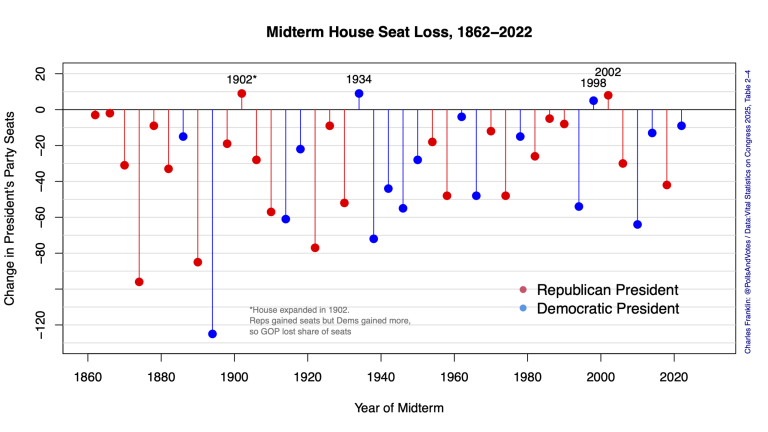
If you’re reading this site, you probably have a basic awareness of how midterm elections typically play out. Generally, the incumbent president’s party loses House seats – this has been true in every midterm in recent decades, save 1998 and 2002. Often the loss is profound: years like 1994, 2006, 2010 and 2018 serve as a shorthand of sorts for election analysts. These were massive and iconic wave elections, with the then-president’s party (Democrats in 1994 and 2010, Republicans in 2006 and 2018) losing 30+ House seats in each and control of the chamber flipped to the opposition.
The Senate is a bit different: because only a third of the seats are up every two years, and because polarization and sorting has left many fewer states competitive, the results have tended in recent years to mirror the recent presidential results in those states. 2018 is a good example: Democrats netted 40 House seats but actually lost ground in the Senate. In 2022, Republicans flipped the House (albeit narrowly) but lost the only Senate seat that changed hands that year.
Thanks to a series of mid-decade redistricting efforts at the state level, the Congressional battleground is quite small unless it turns into an incredible year for one party or the other. I would note that several metrics pointing to this in fact being such a year for Democrats, as I’ll discuss below. In theory, the Senate map should be quite small, too – but Democrats have recruited strong candidates in a number of states Republicans have been winning at the presidential level and often comfortably. Senate polling is highly encouraging. Democrats have a shot at flipping the Senate this year thanks to competitive races in states like Alaska, Iowa, Ohio and Texas, despite recent trends that should make it all but impossible.
Data & Polling
All of the usual caveats apply about the limitations of polling. But I should note that alongside those caveats come the reality that their main weakness in the last ten years or so has come when Trump is on the ballot, and even still they did pretty well in 2024. For all of the hysterics around polling – mostly from extremely-online people engaged in motivated reasoning – the industry as a whole tends to be directionally accurate with respect to issues and “horse race polling.” More often than not, they’re in the ballpark in terms of magnitude, too.
As of this writing, polling is mostly grim for the incumbent president and his party. The Silver Bulletin approval tracker places Trump at 38.2% approval and 58.8% disapproval; that -20.6 net approval is the worst of Trump’s second term so far. And it’s notably worse than Trump’s standing at this point in his first term (-11.3) when Democrats went on to flip 40 House seats a few months later. Silver Bulletin’s generic congressional ballot tracker, meanwhile, gives Democrats roughly a six-point lead (48.4% to 41.9%). For comparison, in 2024 Republicans won the popular vote for the House of Representatives by about two and a half points (49.8% to 47.2%), which yielded a miniscule 220-215 majority. Assuming that this generic ballot polling is remotely accurate, that’ll be enough for Dems to flip the House – though not as resoundingly as they would if the ongoing round of mid-decade redistricting had not occurred.
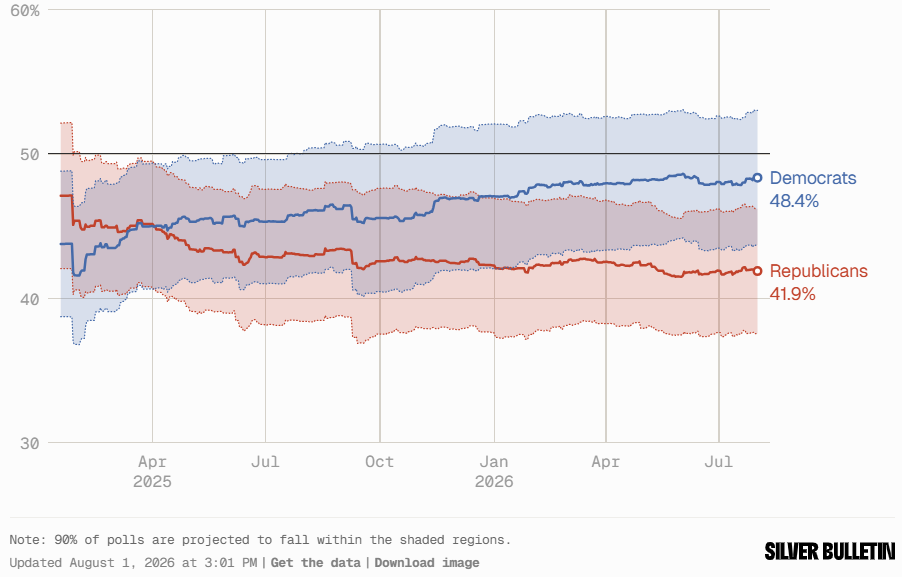
This does not represent quite as decisive a Democratic edge as in the 2018 midterms. This is perhaps counterintuitive, given Trump’s weaker position at this point in his term relative to the early summer of 2018. We might ascribe it to the Democratic brand being weaker than eight years ago – which is another conversation, and one that is probably more important for Democrats to solve by 2028 than it is an urgent problem for 2026. Several recent polls have shown that Democrats have an even larger edge with the voters who indicate a higher motivation to turn out and vote this year, though, so there is an argument that we should expect the Democratic advantage to grow slightly as polls hone in on likely voters in the coming months.
Beyond the generic ballot polling, another useful indicator of political sentiment is Gallup’s quarterly party identification surveys. The most recent data there is for Q2 of this year, with Democrats up 10 (49-39). That figure includes where independents, who initially make up 44% of the sample, are asked who they lean toward. In the final quarter of 2024, during which Trump was re-elected, Republicans held a 47-43 advantage in this survey. Gallup’s website provides this data going back to the first quarter of 2015; that ten-point advantage for the Dems is the largest lead for either party during this period. Pew Research finds a narrower spread, with Democrats leading 47-43 in their most recent party affiliation measure (covering January to June of this year). That still represents a positive trend for Dems, though, as the 2025 edition of this survey returned a 46-46 result and the 2024 edition gave Republicans a 47-46 advantage.
Maps & Gerrymandering
Republicans came out of the 2024 elections with the narrowest House majority since 1930. Even a reasonably popular incumbent would have trouble surviving a midterm with such a small majority intact and this…well, this is not a reasonably popular incumbent. As Trump’s popularity began to fall after weeks of DOGE cuts and especially the “Liberation Day” tariffs, Trump urged Texas Republican leaders to re-draw their Congressional map to eliminate several Democratic seats. The thinking was that they played it too safe with their 2022 gerrymander and that the 2024 elections, with dramatic increase in support for Republicans among Latino voters in Texas (and elsewhere), indicated the GOP could take a more aggressive approach. Texas Republicans complied, devising a map premised on their ability to hold those 2024 gains. It is designed to flip five additional seats this year, though realistically it may fall short – something we’ll examine in more depth in our forecasting later this year.
Democratic-controlled California responded by placing a measure on the 2025 ballot to temporarily replace the maps drawn by their independent redistricting commission with a new map that targets five GOP-held seats.
Other states pursued smaller mid-decade redistricting efforts with varied success. Virginia passed a map that would likely flip three GOP-held seats but their effort was ultimately overturned by the Virginia Supreme Court, with an appeal then rejected by the U.S. Supreme Court.
In North Carolina, where the governor is a Democrat but under state law cannot veto redistricting bills, the GOP-controlled legislature followed their 2023 gerrymander with an update designed to flip NC-1.
Ohio’s 2022 map was only good for two election cycles due to their somewhat goofy laws around redistricting, so they were aways going to attempt a new map for 2026. The GOP-controlled legislature wanted a 13-2 map to replace the current 10-5 map, but this would have again been temporary. They ultimately reached a compromise with legislative Democrats to make OH-1 and OH-9 redder but still not guaranteed to flip.
Missouri passed a new map intended to split the Democratic seat in Kansas City among three Republican districts, while also boosting the GOP vote share in previously most-vulnerable GOP-held seat (MO-2, in the St. Louis suburbs).
Indiana’s Republican-held legislature faced a fearsome push from Trump, J.D. Vance and others to eliminate Indiana’s two remaining Democratic seats (out of nine), but ultimately rejected their demands. For their heresy, a number of Indiana Republican state legislators were targeted by their party for defeat in this spring’s primary elections; most of the targeted incumbents lost their seats.
Following the Supreme Court’s ruling in Louisiana v. Callais, which held that plaintiffs in Section 2 challenges under the Voting Rights Act must demonstrate that a state intentionally diminished opportunities for minority voters because of their race. If a plaintiff cannot “disentangle race from the state’s race-neutral considerations, including politics,” their lawsuits will fail. Most of my readers will understand that this is particularly unreasonable in parts of the country where voting has long been polarized along racial lines. But the majority of our current Supreme Court do not count themselves among my readership, and have now fulfilled one of the longest-running goals for conservatives in America: neutering Section 2.
The immediate effect of this ruling was to strike down Louisiana’s 6th Congressional district, two weeks before the state’s scheduled primary elections for 2026. Governor Jeff Landry moved to suspend those elections to buy the state time to draw new maps; the Supreme Court permitted this and Louisiana soon adopted a new map with a GOP-friendly version of the 6th district. Tennessee quickly followed with a new map that eliminated their only majority-minority Congressional district (the Memphis-area 9th district) and split it among various GOP-heavy seats. In Alabama, early voting for Congressional primaries was already underway: the state nevertheless asked the Supreme Court to restore a map drawn by the legislature that had been deemed a racial gerrymander. The Court complied.
South Carolina governor Henry McMaster tried to follow suit and pass a new map that eliminated SC-6, the already-gerrymandered state’s lone blue seat thanks to its non-white majority. This effort failed when the SC Senate refused to take up the bill.
In Florida, the state’s voter-approved 2010 Fair Districts Amendment sits on the books as a dead letter. In theory, it forbids any Congressional apportionment plan from being “drawn with the intent to favor or disfavor a political party or an incumbent.” Initially, this law – which was supported by 63% of Florida voters in the 2010 referendum – was faithfully interpreted by state courts: Florida’s 2012 redistricting was found to be in violation, and new districts were ordered for the 2016 elections. But in 2022, Governor Ron DeSantis was displeased with the state legislature’s initial set of maps for the new decade. Though drawn by Republicans, those maps did not accomplish what DeSantis was seeking. He ordered a special legislative session and eventually strongarmed legislators into passing his desired map that spring. This extreme gerrymander was ultimately upheld by Florida’s Supreme Court.
But that did not satisfy DeSantis. This spring, DeSantis and Florida’s GOP-dominated legislature passed a new and even more extreme mid-decade gerrymander that turns the current 20-8 map into a 24-4 map for the GOP. The new map was immediately challenged in court, but deemed by a DeSantis-appointed judge to be acceptable: while the Fair Districts Amendment prohibits partisan intent, he observed, the Equal Protection guarantees supposedly set forth in Callais are of greater importance.
If we assume that these various mid-decade redistricting efforts play out as their sponsors intended, the GOP will gain five seats in Texas, four seats in Florida, two seats in Ohio, and one seat each in Alabama, Louisiana, Missouri, North Carolina and Tennessee. Democrats would gain five seats in California and one in Utah (where a court ruled that Republicans had exceeded their authority under the Utah constitution by repealing an independent redistricting law back in 2020, and the resulting map gives Democrats a seat in the Salt Lake City area) for a net of +10 in the GOP direction. As things currently stand, the Republicans likely will not fare quite that well in Texas, and Don Davis is a strong enough incumbent that he may hold on in NC-1. Likewise, the slightly-redder version of OH-1 will likely stay in Democratic hands given this year’s electoral environment, while Marcy Kaptur in OH-9 could plausibly survive yet again in her ever-reddening seat. But the net effect of redistricting will still be a substantial haul of new seats for the GOP – probably in the 5-7 seat range. That makes Democrats’ job harder this year when it comes to flipping the House, but hardly impossible.
Mandates & Vibes
There may come a day when a winning political party does not exaggerate or misread their mandate, but the first half of Trump’s second term as president has not been that time. Others have written as well or better than I can about this, but there was a months-long victory lap among Trump’s supporters that included quite a bit of high profile alignment and/or capitulation from institutions in media, Big Law, higher ed and so on. There was a sense – probably exaggerated at the time but certainly not borne out by events that followed – that we were in a new era, with a certain cultural sensibility in ascendance. But it seems fairly obvious that the 2024 electorate wanted a more affordable America, an absence of chaotic scenes at the border, and a president who could communicate what he’s up to better than Joe Biden often could during his time as president. Instead, we remain sour on the economy. Stubborn inflation has been exacerbated by seemingly-random tariffs and the gasoline shocks brought about by the president’s decision to attack Iran. Chaotic scenes at the border were already on the wane by the end of Biden’s term. But they have been replaced by chaotic scenes in the streets as masked ICE and Border Patrol agents act without basic levels of restraint, oversight or training – and with fatal consequences. And Trump seems to be no more skilled than Biden at arresting a political slide. He’s probably quite worse: while Biden seemed to think people would feel the impacts of his American Rescue Plan much more quickly and personally than he did, at least he was talking about them. Trump talks about ballrooms and reflecting pools when people can’t afford to buy a house, let alone one with a pool. He couldn’t pull off a feel-good event for America’s 250th birthday. He even managed to fuck up the Knicks’ playoff winning streak, briefly interrupting the best run of good vibes New York has experienced in eons.
Maybe there’s a clever political strategy coming down the pike, but it looks like the GOP is out of ideas for the moment other than “make people hate the Dems,” which is not wildly different than what they do the rest of the time and may feel repetitious to voters who are tired of ~gestures broadly~ all of this. Coming into the year, they were talking up a “midterm convention” to charge up the less-engaged segments of their base by making the election about Trump. This idea had some merit, since Republicans have been struggling in recent years when he’s not on the ballot. But with his approval ratings reaching the low 30s in recent polls, it seems likely that making these elections about Trump does them more harm than good. We’ll see – maybe he’s got something up his sleeve for this soiree in Dallas next month. But as things stand, it looks like it’ll just be a two-day Trump rally, with some other speakers thrown in.
About those priors…
On Monday night, I posted some thoughts to make sure they were recorded for posterity before events overtook us and I semiconsciously retconned my priors to match. I approached the exercise with circumspect caution: positive portents abounded in the national polling, the data out of early voting in several states pointed to reasonably strong Democratic engagement levels, and local vibes were good in my homeland of Dutchess County, NY with all its competitive town and county elections. But we just didn’t know enough yet when I wrote those thoughts up. I couldn’t be sure that the national tide had truly shifted, that Black and Latino voters were starting to come back, that the reluctant Trump voters who backed him in ’24 because of cost of living concerns would pivot away from the party that has failed to address them despite unfettered control of the federal government (and here in Dutchess, control of most of county government). I couldn’t be sure that the “Mamdani Effect” that has re-engaged younger voters would overcome the corresponding fearmongering campaigns throughout the country but especially in the Hudson Valley, where the GOP sure seemed to think he was on the ballot in places besides NYC. Funny how they’re quick to condemn people for voting against Trump in local races, though.
So with all that in mind, I offered some tempered optimism: an 8-10 point win for Abigail Spanberger in Virginia with narrow wins for Ghazala Hashmi (lieutenant governor) and Jay Jones (attorney general) but uncertainty about how many House of Delegates seats she’d pull along with her; a 4-5 point win for Mikie Sherill in New Jersey; and juju-proof vagaries in Dutchess County.
Well, Democrats exceeded those expectations, and then some. Spanberger’s winning margin stands at 14.8% for the largest blowout in a Virginia gubernatorial since 2009. Polls close awfully early in Virginia, so the race was called even before Democrats in New York gathered for results watch parties that featured a a newly optimistic tenor. Hashmi and Jones won comfortably, too – however unfortunate that may be, in the latter case.1 In New Jersey, Sherill ran well ahead of most polling for a 13.5% margin of triumph.
Democratic successes were abundant downballot as well. They exceeded even the rosiest expectations for the Virginia House of Delegates, picking up 13 GOP-held seats to grow a 51-49 majority to 64-36, the largest Democratic majority in the Commonwealth since the 1987 elections. In New Jersey, Democrats have flipped three Assembly seats but Republicans concede that two more losses are likely. That’ll bring Dems to at least a 57-23 majority, the largest for either party since the GOP’s 58-seat win in 1991.
In Pennsylvania, where three Democratic justices on the state Supreme Court faced a retention vote, each passed the rest with flying colors – over 61% of Pennsylvania voters opted to retain all three justices. They carried the day in the usual Pennsylvania swing counties like Bucks and Erie, but elsewhere, too. Beaver, Fayette and Westmoreland counties spent decades as mighty Democratic strongholds in southwest PA before moving slowly to the GOP in the 1990s and 2000s, and sharply in the 2010s. But they supported all three Democrats for retention. Blue-trending Cumberland in the south-central portion of the state did, too – a result unthinkable 20 years ago. Luzerne County, home to Wilkes-Barre and Hazleton in the Anthracite Kingdom of northeastern PA, is often used to depict eroding Dem fortunes among working-class voters in the age of Trump. It, too, supported all three Dems. The red-for-decades Columbia, Montour and Union in the Susquehanna Valley? All three. Pike County on the NY border, which has neither an ancestral Dem heritage nor a notable recent trend toward Dems? All three. York County voted to retain two of them and Yes (retain) trails by only 20 votes for the third (David Wecht). Even Northumberland County – where Democrats are a half-century removed from their heyday – supported retention for one of the three.
The downballot triumphs in Pennsylvania are too numerous to list, but highlights include flipping the sheriff and district attorney positions in swingy Bucks County – the latter for the first time since the 1800s. Bucks was ground zero for Moms for Liberty victories in 2021; they were wiped out this time around. Clearfield County gave Trump 75% of its vote a year ago, but Democrat Josh Maines flipped a county court judgeship – beating the incumbent Republican district attorney for good measure. The small borough of Beaver went deep-red even when the surrounding county of the same name was a Democratic stronghold; it last voted for a Democratic presidential nominee in 1912. It had an unbroken streak of Republican mayors dating to World War II. Well, that streak is broken.
To bring it home, I’ll note that in Dutchess County – where I hedged mightily despite increasing signs for optimism as the election drew to a close – Democrats had the strongest night in the party’s history. There have been great federal and state elections before for Dutchess Dems, but in county races, nothing like this. I’ll be writing in more detail in a future post, but Dems held the Comptroller position and flipped a county court judgeship – by margins not previously seen for Democrats in countywide offices. And they decisively flipped the county legislature, last held by Dems in 2008-09, along with a dozen and a half town-level seats.
I was too cautious, it turns out – Democrats won, they won bigger and more widely than both the polls and the incorrigible optimists foresaw, and they did it both via increased turnout over similar contests in previous years and, as Nate Cohn notes at the New York Times, by flipping 2024 Trump voters. What a night. More to come from me on these happenings.
- I rarely vote for a Republican, but I would have in the Virginia AG race because I simply do not believe Jay Jones can hold a law enforcement position with any credibility with his history of graphic, violent texts. I understand all the counter-arguments; I also disagree with them. ↩︎
Very Quick Election Eve Thoughts
Keeping this very brief tonight, but I wanted to check in to deposit a few concepts so that I cannot retcon my priors after tomorrow!
Starting with the big picture: Trump is polling poorly by any standard, including his. He is polling particularly poorly on his handling of the economy and the cost of living – arguably the most critical aspect of his election a year ago. In most surveys, that’s top of mind for voters as is typically the case. Tariff wars, demolishing part of the White House to build a ballroom, fighting with Jimmy Kimmel…these do not make for a laser focus on affordability. The Democratic Party continues to poll at historic lows, but some of that is driven by committed Dems angry at party leadership but still highly motivated to vote against Trump and the Republicans.
On the whole it feels more like 2017 than 2021, as we might expect: there’s a Republican in the White House and negative partisanship is a powerful driver in today’s politics. Accordingly, Abigail Spanberger appears headed for a high-single digit or maybe double-digit win to flip the Virginia governorship back to Democrats. Ghazala Hashmi is probably set to win the lieutenant governor’s race with a smaller margin after a much more lowkey campaign. And potentially completing the trifecta of Democratic flips is Jay Jones, their deeply flawed candidate for attorney general against incumbent Jason Miyares. I do not personally see how Jones can serve in a law enforcement capacity given revelations of horrific, graphic texts he sent a few years ago, but polling shows a very tight race and historically, scandal-plagued candidates often overperform their polling a bit as voters tend to give a socially-desirable response to pollsters.
The New Jersey governor’s race is trickier. Republican Jack Ciatarelli nearly upset Phil Murphy in 2021, and since then we’ve seen New Jersey lurch rightward in last year’s presidential race. Democratic nominee Mikie Sherrill has struggled to close the deal, and I have concerns about whether Trump’s rapid collapse among the non-white voters he flipped last year translates to voting for Dems versus not voting at all this year. I have Sherrill winning, but by substantially smaller margin than Spanberger – let’s call it 4-5% for Sherrill versus 8-10% for Spanberger.
Drilling down much closer to my own context in Dutchess County, I don’t want to engage bad juju by offering specific predictions. It invites extra disappointment if you predict local wins and they don’t happen, and recriminations are inevitable if you predict local losses. So I’m staying above the trees here. The national factors mentioned above, in combination with the shifting makeup of the respective party coalitions in ways that have substantially raised the floor for Dem turnout in off-year races, provide reasons to believe that a strong slate of Democratic candidates can hold the comptroller’s seat, flip a county court judgeship, and flip the county legislature to Democrats for only the third time in our county’s history. There are some hyper-local things to mitigate against that – a boat club controversy in Red Hook, the ever-looming specter of low turnout in Poughkeepsie though signs are encouraging on that front so far – but the much bigger issue in my view is the dichotomy in what drives each party to the polls here. It certainly seems like the GOP can just scream “Mamdani!” over and over and presto, a good chunk of their base buys that Democratic candidates must be socialist, Muslims and whatever else annoys them about Mamdani. But at the same time, in my experience, convincing certain Democrats that a candidate is sufficiently left for their preferences is a massive challenge. Mamdani excites, but proving someone without such a high profile is worth their time – even if their progressive credentials are solidly in order – is an undertaking that is often met with shrugs. I don’t know how to square that circle. And it likely won’t hold Dutchess Dems back if indeed the national tide has truly shifted substantially in Democrats’ direction – but if it has not, it may well prove decisive. Tomorrow will provide much-needed illumination.
Everyone Knows Who’s In Charge
A few days into this federal government shutdown, I began to write how actual public opinion is clashing with the political pundits’ conventional wisdom that Democrats would be blamed for a shutdown. I did not complete that piece immediately – but a week later, polling continues to show Trump and Republicans receiving more of the public’s anger. Let’s take a look at why that is, and why that matters.
The party withholding the votes to keep the government open usually “loses” in the court of public opinion, though the impact of these defeats is often over-stated: see the Ted Cruz-led 2013 shutdown, for which Republicans were blamed and condemned, and then their smashing victories a year later in the 2014 midterm elections. And the party withholding the votes to open the government eventually retreats, having gotten few if any concessions. That remains the likely outcome here as well, and Democratic Congressional leadership has acknowledged as much – while also noting that factional politics within the party demands that they show some fight after eight disjointed months of rather lax opposition since Trump’s inauguration. And so they’re showing it, demanding that the GOP extend Affordable Care Act subsidies whose disappearance will leave millions of Americans unable to afford the coverage they need, and millions of others paying higher premiums as insurers increase costs to make up for the lost customers. Morally, the Democratic position is sound. But there’s some risk here, given the historical pattern of shutdown politics, the Trump administration’s capacity to rebrand federal websites with Blame Democrats messaging (in violation of the Hatch Act, but that’s a dead letter at this point), their ability to make the pain real by shutting down popular parks and facilities, and the inherent contradiction with past Democratic inclinations to keep the government open.
Yet in poll after poll released since the shutdown began, the public blames the GOP right now. To be sure, they blame both parties in part – but the Republicans are getting more of it. Not overwhelmingly, but solidly and consistently. And perhaps that actually makes plenty of sense.
The reality is, Americans are not stupid. They understand who’s in charge in Washington. To the extent normal people have thought about it, they know that Republicans control both houses of Congress. And they know damn well who the president is. They know these things because the Republicans have made sure everyone knows they’re in charge. From the moment Trump’s re-election became apparent the night of November 5, they embarked on a victory lap designed to etch that victory into Americans’ minds as sweeping and historical – even though it was pretty narrow by historical standards. Or by recent standards: see Obama ’08 and Obama ’12. Conservative posters breathlessly tweeted about how “the culture is changing” with every new factoid about young voters or nonwhite voters shifting toward Trump, and with each fresh example of institutional capitulation on the part of media companies or universities.
And then came Liberation Day. The April 2 announcement of a national emergency stemming from the nation’s trade deficit and a series of broad and objectively incoherent tariffs to combat them, sent financial markets into turmoil. When that sort of thing happens, Americans lucky enough to have a retirement account begin to glance at them, and the turbulence that followed Liberation Day did those accounts no favors. And through it all, it was the Trump Show: whatever the merits of protectionist trade policies forty years ago and whatever their merits now, Trump has championed them the whole time. He announced them with his typical bluster and sent his minions to champion them on every news network to make damn sure Americans knew that Trump was in charge of trade policy.
Following Charlie Kirk’s death, Trump and his party – with a few notable exceptions, like Ted Cruz – made damn sure everyone knew they were watching what late-night comedians say, and that they can censor them if they choose. ABC got scared and suspended Jimmy Kimmel before public outcry provided the impetus to reset and put Kimmel back on the air. Amid the Kimmel controversy, public polling showed Trump support declining – and Kimmel’s viewership spiked when he returned to the airwaves (and streaming platforms, of course). Trump might not be in charge of late-night television, but he sure thinks he is. Attacking free speech may be a bridge too far in this country…and Americans knew who was escalating those attacks.
Viewed through that lens, it’s perhaps not surprising that people are going to blame government turmoil on the guys who go out of their way to make sure everyone knows they’re in charge. Public polling consistently shows that self-described independents are livid in general right now – over the cost of living in particular – so perhaps they’re not predisposed to take a positive view of a president who presents himself as an all-powerful, dealmaking force yet cannot keep the government up and running.
I suspect that as the stalemate goes on, the proportion of blame converges toward reflexive partisanship, and our most recent, comprehensive baselines for that is the 2024 presidential result. That would be closer, then, to a 50-50 split. But it’s also possible that views on the shutdown continue to adhere closer to Trump approval/disapproval lines, and that would leave Trump and his party solidly, though not overwhelmingly, underwater on the matter. As of this writing, the Silver Bulletin dashboard shows Trump at 44% approval and 52% disapproval.
While Trump’s ability to dominate news cycle after news cycle and create his own political weather often confounds Democrats, it is not without its risks for him and his party. If you spend each day flamboyantly reminding everyone who’s in charge, you can’t be surprised when you’re held responsible for events. Shutdown politics are proving to be a reminder of that so far, and this one has also created an opening for various Democrats to deploy some effective messaging. AOC and Bernie teamed up for a fun yet substantive walk-and-talk, and even Chuck Schumer managed to do some compelling work with this whiteboard video.
***
It’s worth noting that one way this saga potentially ends is that Democrats let this pass with a simple majority rather than the 60 required to overcome the routine filibuster for appropriations bills, or Republicans change the Senate rules to eliminate it. Republicans have the votes to do either with ease, and the 60-vote requirement is not a constitutional or legal matter. It is simply a Senate rule. Both parties have enacted all kinds of exceptions to the 60-vote threshold; Republicans have already enacted some this year. It is inevitable that it will one day disappear entirely. When it does, America will lose this distortionary mechanism that creates a confusing gulf between electoral outcomes and policy outcomes. Governing parties will gain the responsibility to govern, and parties out of power will have to persuade the electorate to give them a chance instead.
Another Year, Another Special Election Win

And most importantly…a chance to mention the Lincoln Highway!
Coalitions determine election outcomes, and the current sorting of the American electorate is leaving Democrats with a greater share of the highest-engagement, highest-propensity voters. This has limited value in high-turnout, national elections. But it raised the party’s floor in the 2022 midterms despite then-President Biden’s unpopularity, and it has contributed to quite a few impressive performances in special elections taking place outside the normal calendar (i.e. outside November). That includes some victories in reddish territory, and a 2024 near-win in a deep, deep red part of eastern Ohio. That Ohio race turned out not to be remotely indicative of a Democratic comeback in the Buckeye State, as Trump went on to win the district and state by considerably larger margins than he had four years earlier. Instead, it served as a demonstration that many of the most-engaged voters are Dems even in heavily Republican areas, making them a higher proportion of the electorate in a low-turnout contest.
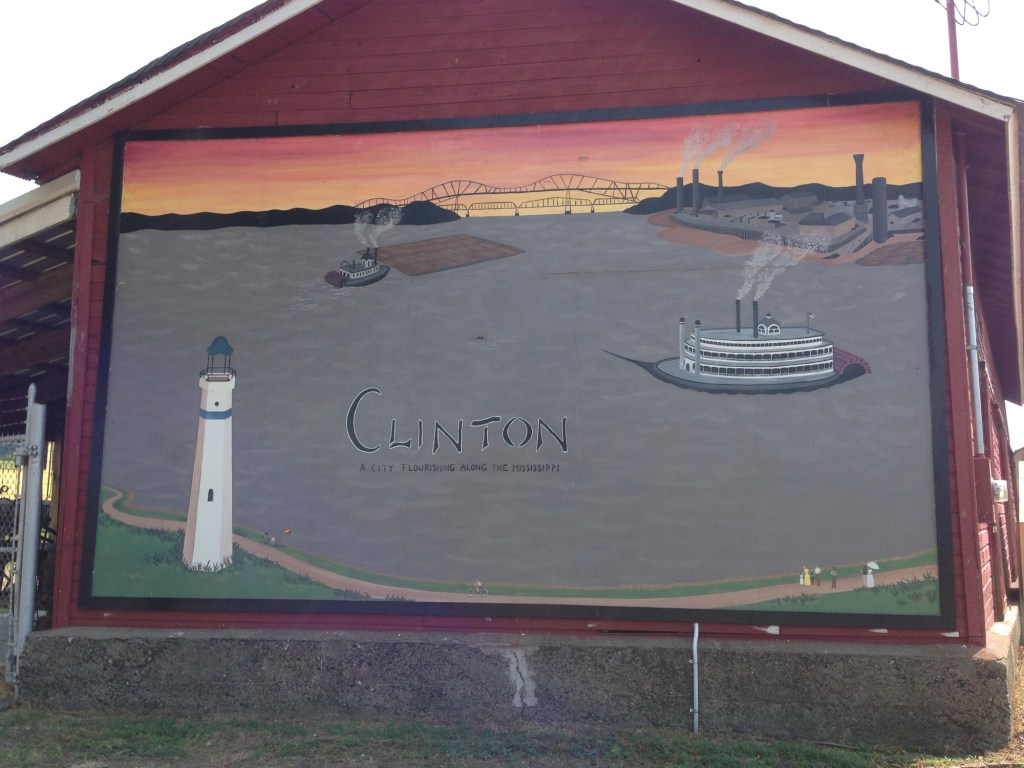
And so it is that we have last week’s impressive triumph for Democrat Mike Zimmer in Iowa’s 35th Senate District. This was a special election called after incumbent Republican Chris Cournoyer vacated the seat upon her appointment as Iowa’s lieutenant governor. This is a great district: it includes all of Clinton County, and small portions of Jackson and Scott counties to the north and south, respectively. Clinton County is home to Clinton, right on the Mississippi River. It’s the first place I ever visited in Iowa, on my Lincoln Highway road trip back in 2013. The Lincoln enters Iowa on U.S. 30, crossing the Mississippi from Illinois. Clinton’s a cool place, with paddlewheel logo and its river-town vibes; this is the Midwest but maybe with a slightly Southern touch. Until 2020, they had an affiliated minor league baseball team; after MLB’s purge, it’s a collegiate summer league team these days. Clinton (both city and county) have been declining in population for decades. I’m sure it has its issues. But to my eyes in 2013, this district seemed like a cool and unique place to live.
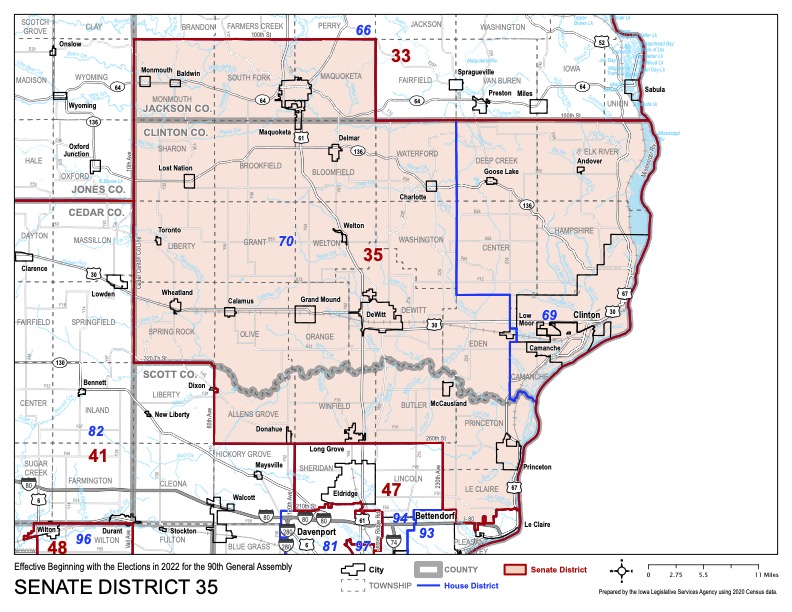
These days, it’s also a very red district. It supported Trump by 21(!) points over Kamala Harris last year. That’s quite a change from the Obama years, when he won this area by about the same margin – twice. But then Democrats began to plummet among the white working-class voters who make up a large portion of the electorate here and in most of Iowa, so it’s firmly Trump Country today. Downballot, this state senate seat flipped to Republicans in 2018 even as Democrats enjoyed a good year nationally; in 2022 Cournoyer was re-elected to the renumbered district by 22 points.
You wouldn’t know that from this special election, though. Zimmer won by almost four points, flipping a seat that will be hard for Democrats to hold in 2026 – but in the meantime gives them a new voice in the GOP-dominated Iowa legislature. He lost the Scott County portion by 12 votes. But he won the small Jackson County portion by over a hundred votes, and the Clinton County portion – which makes up 70% of the district – by a couple hundred. I had a feeling coming into it that this might be brewing, given recent history in special elections along with the timing: a week after Trump’s inauguration seems like a good time for Dems to blow off some steam by voting, even in a contest far removed from the maelstrom in the nation’s capital.
It probably helped, too, that this election took place last Tuesday in the midst of confusion over Trump’s freeze of trillions in grant spending. Every local government and not-for-profit entity that receives any kind of federal money was facing uncertainty over what comes next, without any guidance from an administration hellbent on embodying the Silicon Valley credo of moving fast and breaking things. A day later, the White House rescinded the freeze. But some damage was done, and that may have been reflected in the result – especially in an election with such a tight turnaround, leaving little time for absentee voting. So most voters were likely voting on Election Day itself, and the latest dose of Trump chaos probably did not dispose them favorably to the GOP.
There’s a clear trend in recent years in special elections up and down the ballot, all over the country. But where special elections used to be more indicative of performance in coming general elections, the relationship has changed a bit thanks to Democrats’ increasing dominance among the people most likely to turn out in any given contest. That said, winning in such deep red turf points, at minimum, to Dem voters retaining their engagement despite the national discourse declaring them to be in the midst of a period of wound-licking and navel-gazing.
The Eyes Wide Open Election, Part 4: Psalm
[continuing a series on the election that was. To read “Part 1: Acknowledgement,” click here. To read “Part 2: Resolution,” click here. And to read “Part 3: Pursuance,” click here.
“In the bank of life isn’t good that investment which surely pays us the highest and most cherished dividends?”
– John Coltrane, notes to “A Love Supreme”
The confidence with which each side of the American political divide presents themselves as righteous and good is for many people one of the great turn-offs of our political discourse. Perhaps that’s why Trump, his party and his supporters now try to have it both ways: presenting as God’s chosen messiah (“I was saved by God to make America great again“) while also reveling in villainy, in cancellation, in being assholes who hurt people – but assholes on your side. Self-consciously positioning as the opposite of that – on the side of democracy, on the side of maliciously-targeted groups – has produced limited success for Democrats. I’m not about to suggest that Dems attack the same people, or embrace authoritarianism. We should continue to be, for lack of a better term, the good guys, and let Trump and his flock be the villains/false idols they so desire to be. But by itself, we now know that won’t be enough. So we need to find another way to reach people.
We’re in the midst of a substantial political realignment along educational lines and along levels-of-engagement lines. I generally believe that Democrats will come out on the short end of this realignment, but will achieve intermittent electoral success should Trumpian chaos leave voters short-tempered in lower-turnout elections. I could see the former changing if a Dem breaks through at the national level with a message outside the usual left/center-left dichotomy into less-charted territory relating to how screens and social media platforms and artificial intelligence have frayed, and will fray, our societal bonds. This terrain maps less neatly onto our political divides, meaning it offers the chance to build new coalitions.
To everything there is a season, and in this season it seems more practical for me to read, think and write about past realignments and those presently underway than to do the hamster-wheel work within the party. That’s not to say the latter is unimportant – but one must understand what they have available to offer at any given time. Pretending that everything is normal and we just go about our business with the same political strategies and structures as before? That seems naive. I need to go away and dream it all up again, to quote Bono back in 1989. I’ll very much still be following elections and commenting on them – but on the ground, right now, it falls to someone else to do the party work and the voter contact and all that. When I’ve had some time to dream up something new and find myself having something to offer, I’ll get back to that kind of work, and I hope the Democratic Party will be ready when I am.
***
These four pieces are the most forced things I’ve written in a long time. I’m not sure how I feel about them. I suspect I will not look back favorably on them for their style or construction or most certainly their titles, and I suspect I’ll be annoyed most of all at their lack of insights. But at least I acknowledge a lack of insight, at a time when so many Democratic electeds and “leaders” would have us believe they have the answers when in fact they’re stunned, directionless and simply waiting for something to happen.
The Eyes Wide Open Election, Part 3: Pursuance
[continuing a series on the election that was. To read “Part 1: Acknowledgement,” click here. To read “Part 2: Resolution,” click here.]
It is one thing to acknowledge the world as it is, another to evaluate competing narratives around it, and another, far more challenging thing to determine where I think the Democratic Party goes from here. I think there are a few obvious elements when it comes to strategy and infrastructure:
- Playing to the cable news audience is a fool’s errand. Personally I’d rather news just be, you know, news. There’s room for talking heads on cable news just as I believe there’s room for editorial pages in a newspaper – but the ratios ought to be very different than they presently are. But if cable news is going to operate the way it currently does, and include an ideological bent, I don’t think the Democratic Party or its officials need to play along. The MSNBC crowd does a better job of sharing facts with their viewers than, say, Fox News. But it does little to encourage viewers to understand the electorate around them, and every minute Democratic figures spend talking to high-info base voters is a minute that could have been spent trying to reach people who oscillate between engagement and non-engagement, or the even smaller portions of the electorate that splits their tickets or swings between parties from one election to the next. This seems like an incredibly obvious point, but it’s stunning how much time Democrats spend talking to their most fervent supporters at the county, state and national level. It’s stunning when you watch it up close in local politics, and stunning when you watch it from a distance on the national scene.
- A lot of folks seem to understand that the political consultant class adds little. Coin flip national elections have become the norm, and we win them about as often as we would a…coin flip. It was clear in 2016 that Democrats faced softness with white working-class voters, and Biden barely improved on Hillary Clinton’s margins with these voters in 2020. It was clear in 2020 (and every subsequent year) that Democrats now also faced softness with Black, Latino and Asian working-class voters, and Dems went backwards with these voters in countless elections in 2021, 2022 and 2023. Everyone knew, in other words, that Democrats faced a challenge in reaching working-class voters across the demographic board in 2024. And yet the consultants paid to win elections could not develop a plan to turn the tide. The reality is campaign fundraising for federal elections is easier than ever, and the consultants get paid – win or lose. And then they usually get hired again. So a lot of our supporters’ hard-earned money is going to people who spend December vacationing on a beach whether they’ve won or lost the previous month. Democrats need to re-assess who actually adds value when it comes campaign infrastructure. This, again, seems like an incredibly obvious point. And yet it doesn’t happen. Professionals who can make campaigns more of a turnkey operation likely raise the floor in electoral performance, but I’m worried it lowers our ceiling and leaves us dependent on how the national-level coin flip lands. Maybe Democrats need to run candidates who devise their own bespoke strategies based on their feel for their communities – and if they don’t have that feel, if they have nothing distinctive to offer on their own without having consultants craft it for then, they need not to run.
- In a time of low social trust with lower contact rates from phonebanking and doorknocking, I’m not sure that the classic campaign field tools should be relied upon as much. It’s not 2008 or even 2018 anymore, but you wouldn’t know that from the endless speeches from well-meaning organizers about how we need to be pounding the pavement. That said, I remain interested in well-meaning organizers who are immersed in a community for several cycles and can develop a feel for what works and what does not. I’m certainly open to returning to and expanding the Dean-era 50/50 state strategy. I’m interested in moving away from the “gig economy” model of organizing toward something that provides living wages, benefits and stability for a larger number of organizers than we’ve previously done in our allegedly pro-labor party.
Messaging, policy and strategy present questions – with much less obvious answers – of how to pursue electoral success in a second Trump term.
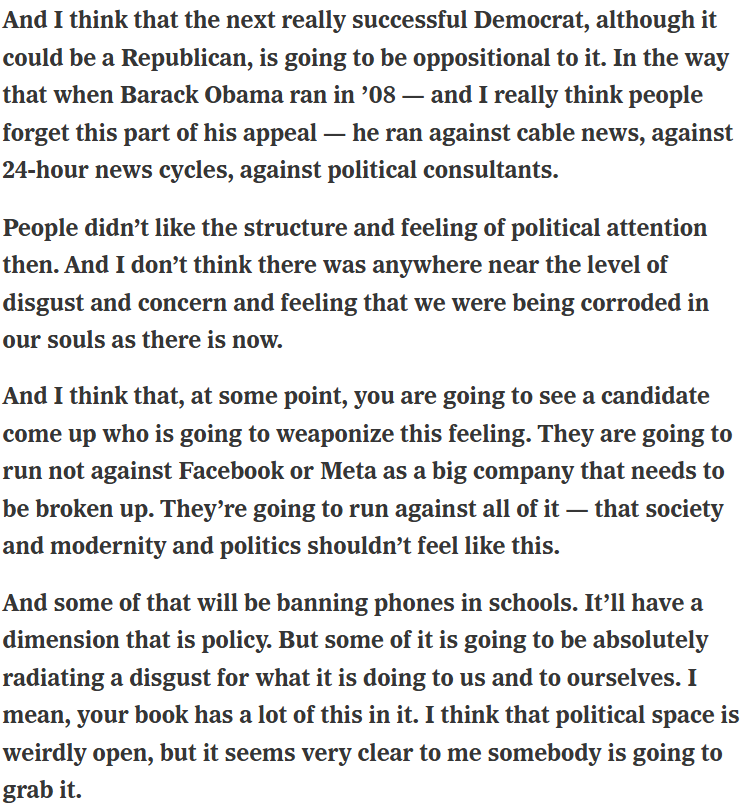
- I’d start by pulling back from left/right or economics-versus-culture wars dichotomies and ask how Democrats assess the wider societal dynamics that got us into the Trump Era. Democrats are losing the war for attention, in part because the party styling themselves as overturning the present order are going to have the upper hand in winning eyeballs. There’s a lot of discontent in the post-pandemic world, and it’s easer to tap into that than to defend an unpopular status quo as Democrats found themselves doing in the Biden years. But there’s a larger question to be asked about the attention economy and its impact on how people view contemporary life. I’m always saying that this timeline we’re in just doesn’t “feel right” – and screens and social media and the homogenizing of American communities might have something to do with that feeling. I think there’s room for someone to demand that we pump the brakes on our screen-induced devolution and to resist the mega-corporations at the core of that decay. Ezra Klein recently discussed this idea on his podcast with guest Chris Hayes, arguing that aspects of this sensibility are widespread and that the next really successful national candidate – from whichever party – might be the one that taps into those feelings. I tend to agree. The transcript is worth a read, but here’s the passage I found most resonant:
- I’d widen that brake-pumping – or preferably, outright reversal – to AI’s growing infection as well. And lest you think I’m falling into the trap I often lament and suggesting that a candidate who conspicuously and conveniently echoes my own beliefs is the one who’ll carry the day, let me offer a couple of caveats. I have no idea if this narrative will produce electoral majorities. But I think there’s a space for it that someone would be wise to fill, and a wayward Democratic Party that frankly isn’t doing any other big-picture projects ought to do it. And I’m being consistent: I’m not spending time in this space suggesting that Democrats focus heavily on foreign policy concerns that are of major interest to me…and not too many other folks. I predicted in 2002-03 that following up our Afghanistan nation-building efforts with an invasion and occupation of Iraq would not only become massively unpopular (it did) but would launch a generation of isolationism in response, uniting Americans on the political right and left against overseas involvement. It did, with Trump’s America First agenda reaching escape velocity as a result. It is damn near impossible to have serious discussions about international security, inside our party and among the wider polity. That frustrates me to no end, but I’m not going to suggest that the electorate is willing to re-engage on foreign policy and national security outside of yelling at each other in an often-reductionist fashion about the existential threats facing both Israelis and Palestinians.
I’d like to feel more confident that something like what I’ve described above is at hand, but I’m still seeing too many Democrats engaging in tired defenses of Biden’s political strategy or arguing that we just have to wait for Trump to mess up, and then we’ll be ok. The latter might produce some midterm wins, but it’s not clear to me that it won’t be too late at that point to roll back a lot of damage in both policy terms and to small-d democratic governance. And it’s not clear that it will create national majorities in 2028 and beyond.
The Eyes Wide Open Election, Part 2: Resolution
[continuing a series on the election that was. To read “Part 1: Acknowledgement,” click here.]
Democrats are doing the usual Democratic thing: analyzing the defeat and suggesting changes.
That’s healthy, in theory. It’s what normal political parties who assume their viability is more or less tied to the popularity of their specific policies would do. There’s a catch, though: just as predictably, the ideological bent of too much of the Democratic post-mortem discourse has been eyeroll-inducing. The party’s left flank argues that if only Dems embraced more leftist positions, new voters would stampede to the polls in support. It’s probably worth noting that Bernie Sanders1 and Elizabeth Warren2 received fewer votes than Kamala Harris in their respective states – though I’ll acknowledge those states are not demographically representative of “swing” states. Centrist Dems outran Harris in some of the toughest Congressional seats that Democrats held (see ME-2 and WA-3 for two good examples). At the same time, centrists argue that Dems must tack to the center to win back voters who have drifted to the GOP…but they mainly focus on what not to talk about rather than an affirmative set of policy prescriptions. Voters quite clearly signaled in the years leading up to this election that their primary concerns were inflation and immigration, so after-the-fact prescriptions about rejecting “wokeism” or embracing Medicare For All do not ring true – even if I tend to agree that the language Democrats use around certain issues is unhelpful, and agree wholeheartedly that Democrats would be wise to attack (legislatively as well as rhetorically) consensus evils like the outrageous, patient-killing tactics employed by private insurers.
Republicans are doing the usual Republican thing: exalting in victory and over-claiming their mandate. They had Sen. Bill Haggerty of Tennessee on Sean Hannity’s show shortly after the election declaring that “Trump certainly has a mandate that we’ve never seen before.” Countless Republicans have echoed the sentiment. In reality, Trump’s margin of victory ranks quite low in terms of the popular vote, with his vote share coming in under 50% and his lead over Kamala Harris ending up at less than 1.5%. That is the seventh-smallest popular vote margin since the Civil War. It’s wider in the electoral college, which is obviously the ballgame: but a 1.5% shift in the three closest states gives Harris an electoral college win, so we’re still not talking about big margins. Trump won, and no one disputes this. But the idea that it’s a large, historic mandate is confounded by simple math. His mandate in mathematical terms is nowhere near Biden’s, or either of Obama’s; even George W. Bush’s 2004 win came with a considerably larger popular vote share. But many media outlets are currying favor with the incoming administration and Congressional majorities. We’ve seen the settlements with Trump over lawsuits, which feel a bit like bribery. And they’re eager to be seen as ratifying voters’ choices and perhaps to attract Trump voters back to legacy media outlets they’ve long since abandoned. So the tenor of coverage presents an incongruously imperious political position for a party whose presidential candidate won narrowly and is currently polling five points underwater, and whose House majority is the smallest any party has enjoyed since 1931.
People who spend their time dismissing parties and elections as a means of improving the world are suddenly finding out that those things do in fact matter.
One can find folks online – and definitely in my own real-life circles – saying, “wait, Democrats prophesied doom if Trump won – why are they carrying on now like everything is normal? Heavens, why…why aren’t they DOING SOMETHING about it?” Folks, this isn’t hard: they argued the election was critically important *because* of the lack of things you can do when all the guardrails have been stripped away, which already happened: the Supreme Court has rolled over for Trump. His party, which now controls both house of Congress, long ago rolled over for Trump. Yeah, they’ll draw the line at a Matt Gaetz attorney general nomination, but not much else. What do you want Democrats in Washington to do? Chain themselves to desks? Get arrested? Your mileage may vary, but I’m not interested in performance politics right now. As Jonathan Van Last notes, most of the remaining power of resistance is in the hands of bureaucrats – the so-called “Deep State” – to work quietly – unseen – to delay harmful actions. In sum, Democrats said the election had existential stakes precisely because the last eight years have eroded the options to resist.
That being said: sure, I would rather Biden have dispensed with now-obsolete niceties like posing for pictures with the president-elect – especially if by pardoning his recidivist son, he was going to make politics harder for those of us tasked with carrying the torch for this declining, atrophied party in the aftermath of his presidency. I would rather Democrats have repaired any number of long-standing structural problems involving special counsel authority, ethics for federal judges, and background checks for cabinet appointments, to offset some of the erosion in guardrails in the Trump era. I would rather Senate Democrats have use their appointment powers to maximum effect in the lame duck period, but former Democrats Joe Manchin and Kyrsten Sinema are a limiting factor. And I’d rather responsible non-Democrats like Christopher Wray not resign as head of the FBI and instead make Trump actually fire him, so as to put more cards on the table for more people to see. But none of these individuals are behaving responsibly or effectively. They’re confused and capitulating. Caveat: David French offers another take on Wray’s decision.
Even as I write this, the Democratic leaders in the House and Senate are responding in slow-motion – to the extent they’re responding at all – to Elon Musk’s friends potentially taking over payment systems at the Department of Treasury, or the firing of over a dozen prosecutors at the Department of Justice in retaliation for previously investigating Trump. It may be that to truly change the political dynamic, you have wait for Trump, Musk & Co. to do something that breaks through to people. But you still have to provide your own supporters with something to grasp onto to take advantage of those eventual mistakes.
- my preferred candidate in the 2016 primaries – but it’s complicated and I came to regret that. Whatever her faults, Hillary Clinton deserved better in those primaries, and obviously in that general election. ↩︎
- my preferred candidate in the 2020 primaries – after which I had to reckon with the reality that I am not particularly representative of the vast majority of the population. ↩︎
 Within the Margin